Murder mystery party games
A murder mystery party game turns a dinner party into a plot. Every guest plays a suspect, a fictional victim meets an untimely end before dessert, and the room spends the evening trading clues, poking holes in alibis and finally voting on who did it. It's part dinner, part puzzle and part improv, but nobody has to memorize lines or deliver a monologue. The talkers get a stage, the quiet observers get to crack the case, and everyone goes home with a story they'll be retelling for months.
This page is the map. Below you'll find what actually happens during a game, an honest look at boxed, printable and custom-written games (each one suits a different kind of host), how to match a theme, a player count and an occasion to your crowd, and a checklist for the night itself. Browse all 8 themes, from a Roaring Twenties speakeasy to a Las Vegas casino night, or jump straight to your group size, your occasion or one of the hosting guides.
Killer Cast writes a custom case for your guest list, checks it for fairness and casts your friends as the suspects, with optional illustrated portraits made from their own selfies. The advice on this page works with any game, though. If you'd like to try the format before spending a cent, start with the free printable 6-player mystery and the name, invitation and costume generators.
Pick your
era

Roaring Twenties Speakeasy
Passwords at the door, hot jazz in the air and a body behind the bar. Your friends are the bootleggers, bandleaders and big shots, and one of them did it.

Old Hollywood Awards Night
Red carpet, flashbulbs and a sealed envelope worth killing for. Your friends are the stars, the studio bosses and the scandal sheets, and someone won't make it to the last award.

Wild West Saloon
Swinging doors, a crooked card game and a stranger who rode in at sundown. Your friends are the sheriff, the gamblers and the townsfolk of a silver-rush boomtown, and one of them is hiding more than an ace.

Victorian Christmas Manor
Candlelight, carols and a family fortune waiting for midnight. Your friends are the heirs, the household and the unexpected guests snowed in at Holloway Hall, and somebody is getting more than coal this year.

New Year's Eve Masquerade Gala
Black tie, hidden faces and a countdown that ends in murder. Your friends are the masked suspects, and the killer has to be unmasked before the clock strikes twelve.

Haunted Mansion
Candles, cobwebs and a séance that goes horribly wrong. Your friends are the suspects, and the house remembers everything.

Pirate Ship
A pirate crew, a chest of gold and a body on the deck at dawn. Every friend is a suspect, and every suspect has a share to protect.

Las Vegas Casino Night
Neon, sequins and a jackpot someone would kill for. Deal your friends in as the suspects of a 1970s casino night gone wrong.
By group size
By occasion
Free for hosts
What the game actually is
At its heart, a murder mystery party is a story the guests tell together. Before the party, each guest receives a character: a name, a short public bio that everyone may know, a costume idea and a handful of private secrets. Once everyone has arrived, a fictional victim (never one of the guests) is discovered, and the evening becomes a polite, well-dressed interrogation. One of the suspects did it. Everyone else is innocent of the crime, but almost nobody is innocent of everything, and that's where the fun lives.
The night unfolds in rounds. A typical 120-minute game runs like this: 20 minutes of arrivals and in-character mingling, a 10-minute opening scene where the crime is announced, three clue rounds of about 20 minutes each, 10 minutes for written accusations, a 10-minute reveal and 10 minutes for awards. A 90-minute game trims each round to around 15 minutes, and a 150-minute game gives big groups room to circulate. In every round, players receive new information, share the clues they're required to share and decide how much of the rest to give away.
Two details separate a satisfying game from a frustrating one. One is fairness: every fact needed to solve the case should come out during the night, so a sharp guest could reason their way to the answer before the reveal. Red herrings are welcome, but each one needs an innocent explanation by the end. The other is that every character needs a reason to talk. A suspect with a secret, a grudge or an alibi that doesn't quite hold up will chat all night; a suspect with nothing to hide drifts to the snack table by round two.
That's also what makes a murder mystery party different from an escape room or a detective box. Players aren't detectives studying the story from outside; they're inside it, with motives to defend and reputations to protect. Even the culprit plays along, usually knowing their guilt from the start and bluffing for two hours. The format works for groups of 6 to 20, for confident performers and shy guests alike, and it stays comfortably PG-13: the drama comes from secrets and suspicion, not from anything grisly.
Boxed, printable or custom
Boxed games arrive as a physical kit: character booklets, sealed envelopes and sometimes props like a map, a ledger or a fake key. They're satisfying to open, need no printer and make a lovely gift. The trade-offs are timing and flexibility. Order two to three weeks ahead to be safe, and know that the cast is written for a set number of players, so if two guests cancel the day before, the plot may lean on characters nobody is playing. With most boxed kits the host reads the solution in advance and runs the game instead of playing it, and once the story has been played, it's spent.
Printable games are files you download and print at home. They're instant, usually cheaper than boxed kits, and there's a title for almost every theme. The cost is your time: plan on one to two hours to read the host guide, print the booklets, sort clues into rounds and fill the envelopes, plus ink and paper for dozens of pages. The script was written for any group, so the jokes aren't about your friends, and many printables are built around a fixed cast with a few optional characters you can add or drop. Check the player range carefully before you buy, and check whether the host has to know the answer.
Custom-written games are created for your guest list. Instead of a fixed script, the case is built around your exact headcount and a harmless fun fact or two per guest, so the inside jokes land and nobody gets a role written for somebody else. If the solution is kept from the host, the host can play as a suspect too. The trade-offs: you'll need to collect a few details from each guest ahead of time, the quality depends on how carefully the case is constructed, and you should find out how the game copes with change. Ask any custom game three questions: is the case checked for fairness, can you re-cast for free if the guest list shifts, and what happens if someone doesn't show up?
Here's how Killer Cast answers them. Each case is written by AI for your guest list and then checked for fairness, so the clues needed to solve it are actually in the game. Re-casting is free until 24 hours before the party, every case includes 2 standby characters for surprise guests, and a no-show's must-share clues move to someone who is there. You can preview the title and cast for free, then pay once: $24 for the Party (up to 12 guests) or $39 for the Big Party (up to 20), with no subscription and a refund promise. It's 100% digital, with an optional print-at-home kit for anyone who wants paper in hand. If you love unboxing props, a boxed game may suit you better, and if your budget is zero, start with the free printable mystery.
Theme, group size, occasion
Start the theme decision with the closet test: could every guest put together a costume from what they already own plus one purchase under $10? The most forgiving themes are the Wild West Saloon (boots, a bandana, a hat), the Pirate Ship (a striped shirt, a sash, a headscarf) and the Las Vegas Casino Night (anything sparkly, or a vest and visor for the dealer look). The dressier picks are the Old Hollywood Awards Night, the Roaring Twenties Speakeasy and the New Year's Eve Masquerade Gala, where a $5 mask instantly levels up any outfit. Two themes are seasonal by nature: the Haunted Mansion owns October, and the Victorian Christmas Manor practically decorates itself in December.
For player count, 8 to 12 is the sweet spot: enough suspects that the answer isn't obvious, and few enough that one conversation can hold the whole room. Six players makes a lively dinner-table game where everyone gets plenty of airtime, and a 90- or 120-minute game suits it well. At 15 to 20 players the party naturally splits into smaller huddles, so choose a 150-minute game, use a bell or a speaker to announce each round, and set up two rooms or zones where suspects can corner each other. Whatever your target, expect one or two last-minute changes and choose a game that can absorb them.
The occasion shapes the tone. Milestone birthdays shine with an awards night or a speakeasy, and a bachelorette party suits a casino night played strictly for laughs. Friendsgiving and dinner clubs can line the rounds up with courses: appetizers during arrivals, the main course during round two and dessert with the reveal. For New Year's Eve, start a 120-minute game at 9:45 p.m. so the reveal and awards wrap up by 11:45, just before the countdown. Book clubs often prefer a classic tone with a meatier puzzle, and office parties do well with a 90-minute game and in-jokes that stay strictly about work, never about anyone's private life.
Family reunions and mixed-age groups need a little extra care. Choose a forgiving costume theme like the Pirate Ship or the Wild West Saloon, and with Killer Cast switch on family mode, which skips selfies and gives every character a drawn look instead; hosts and anyone uploading a selfie must be 18 or older. Across every occasion, tone is the final dial. Classic plays it straight with a proper puzzle, comedy leans into ridiculous motives and big personalities, and spooky adds candlelight and creaking doors while staying PG-13. When your guest list mixes in-laws, coworkers and old friends, classic or comedy is the safer bet.
What you need on the night
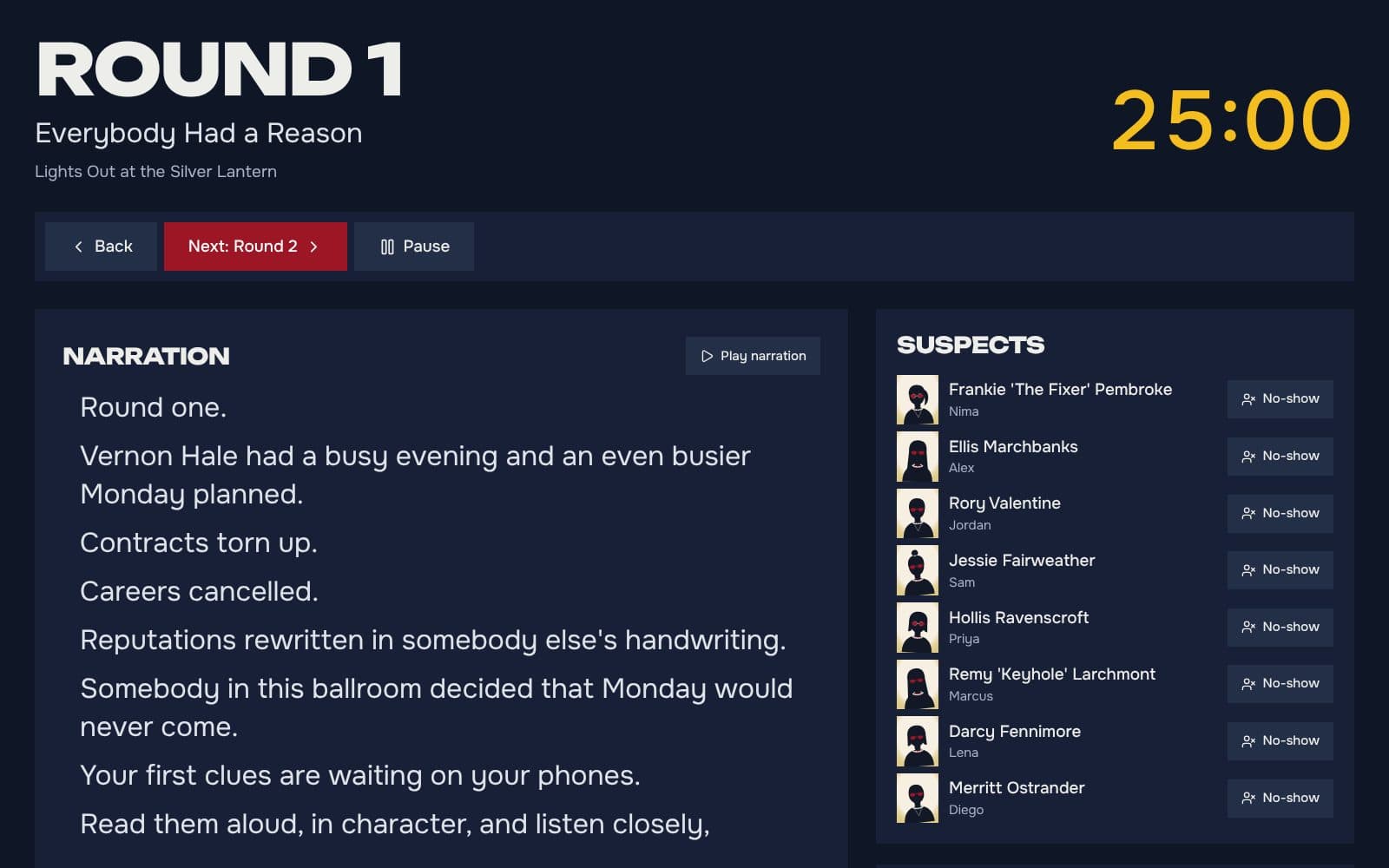
The game comes first, so check it the day before rather than an hour before the doorbell rings. For a boxed or printable game, that means character packets sorted by guest, clue envelopes labeled by round and the solution sealed somewhere nobody will knock it over. With Killer Cast, guests open their character and the Evidence Locker on their phones: letters, newspaper clippings, receipts, voicemails, a red-string board, a timeline and a lock-box puzzle that unlock round by round. Narrator audio with captions plays from any TV, laptop or phone, and the optional print-at-home kit covers anyone who would rather hold paper.
Then come the small things that make a big difference. Name tags with character names are essential above 10 guests, because nobody remembers who the shipping heiress is by round three. Put out pens and index cards for accusations, keep a visible clock or a phone timer running for each round, and make sure the narration can be heard over the chatter; a $20 portable speaker plugged into a laptop beats a phone propped on a shelf. Set aside one table or wall as the crime scene, with a few props and a length of caution tape, so the evidence has a home and guests have somewhere to gather.
Food should work with the game, not against it. Finger food and a single main that can sit on a buffet are far easier than a plated three-course dinner you have to serve mid-interrogation. Make one signature drink plus a zero-proof version, swap overhead lights for lamps or battery candles (real flames and feather boas don't mix), and keep instrumental music playing at low volume. Most themes are easy to match by ear: brassy jazz for the speakeasy, big-band swing for Old Hollywood, honky-tonk piano for the saloon and sea shanties for the pirate ship.
Finally, plan for the hiccups every party has. If a guest cancels at the last minute, someone has to carry that character's must-share clues: with a printed game, hand them to the host or another player to read aloud, and with Killer Cast, mark the no-show and their must-share clues move to someone present. Surprise plus-ones can step into one of the 2 standby characters, and a latecomer can catch up in two minutes by reading their character's public bio. Close with awards (best costume, most convincing liar, sharpest detective) and something to remember the night by. Killer Cast ends with a party recap and awards that guests can share, which keeps the group chat buzzing the next morning.
Questions
How many people do you need for a murder mystery party game?
Six is a comfortable minimum and 20 is a practical maximum for one home. Most games feel best with 8 to 12 players. Killer Cast cases work for 6 to 20 players: the Party covers up to 12 guests and the Big Party covers up to 20.
How long does a murder mystery party game take?
Plan on about two hours for a typical game: arrivals, an opening scene, three clue rounds, accusations, the reveal and awards. Groups of 6 to 8 can finish comfortably in 90 minutes, and groups of 15 or more are happier with 150. Add extra time if dinner is served before the game starts rather than during the rounds.
Can the host play the murder mystery too?
With most boxed and printable games the host reads the solution in advance, so the host runs the night. With Killer Cast the host doesn't choose who gets which character or who the killer is, so you can play as a suspect and be as surprised as everyone else, or simply run the game.
Do guests have to act or memorize lines?
No. Players read from their character materials and can stay as low-key as they like. Some guests will put on an accent and go full drama; others will ask sharp questions and share their clues when the round calls for it. Both styles keep the game moving.
How much does a murder mystery party game cost?
It depends on the format. Printable games are usually the least expensive, boxed kits cost more and add shipping, and custom games vary. Killer Cast starts with a free preview of the title and cast, then a one-time payment of $24 for up to 12 guests or $39 for up to 20, with no subscription. The free printable 6-player mystery costs nothing at all.
Does Killer Cast ship anything?
No. Killer Cast is 100% digital and nothing is shipped. Private invite pages, the Evidence Locker and the narrator audio all open on the phones, laptops and TVs you already have, and an optional print-at-home kit is there if you want paper clues on the table.
On party
night
The real screens from a sample Old Hollywood Awards Night party. Your guests get their own, written around your list.
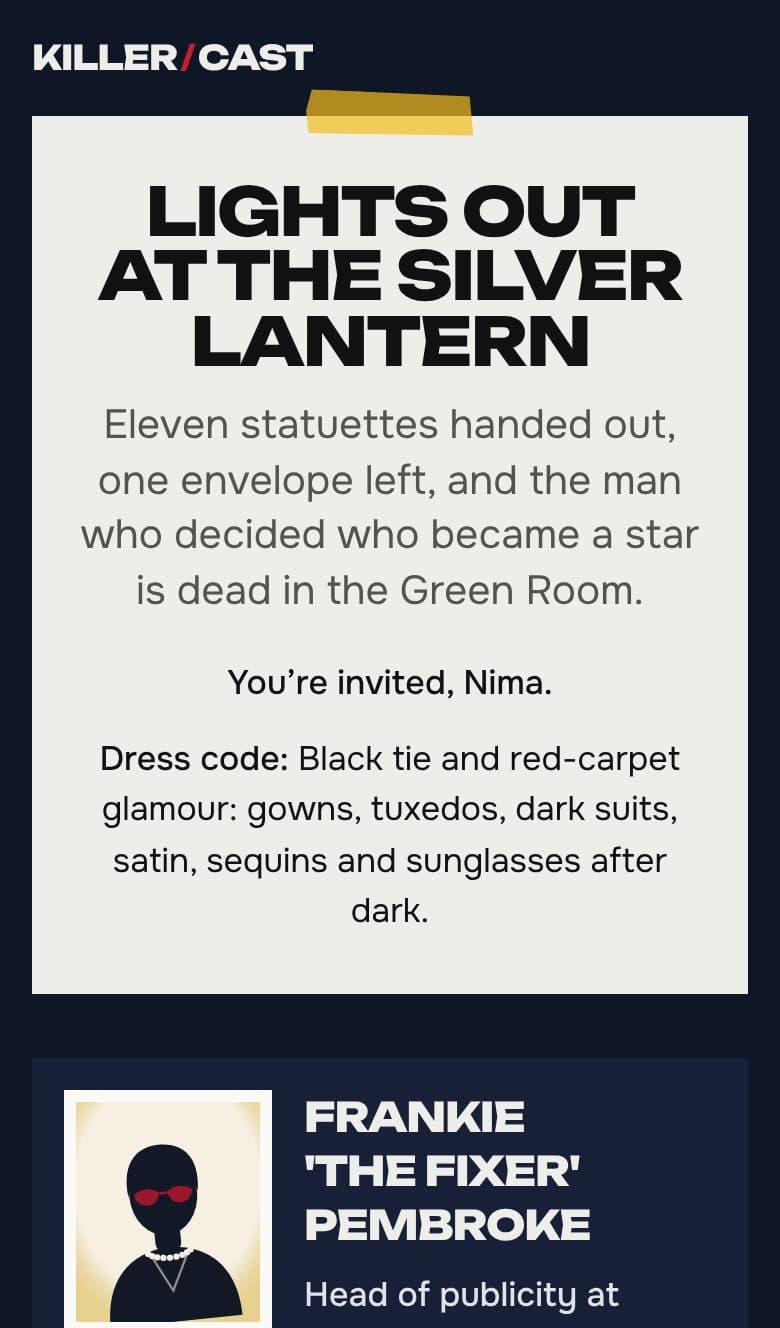
The invite 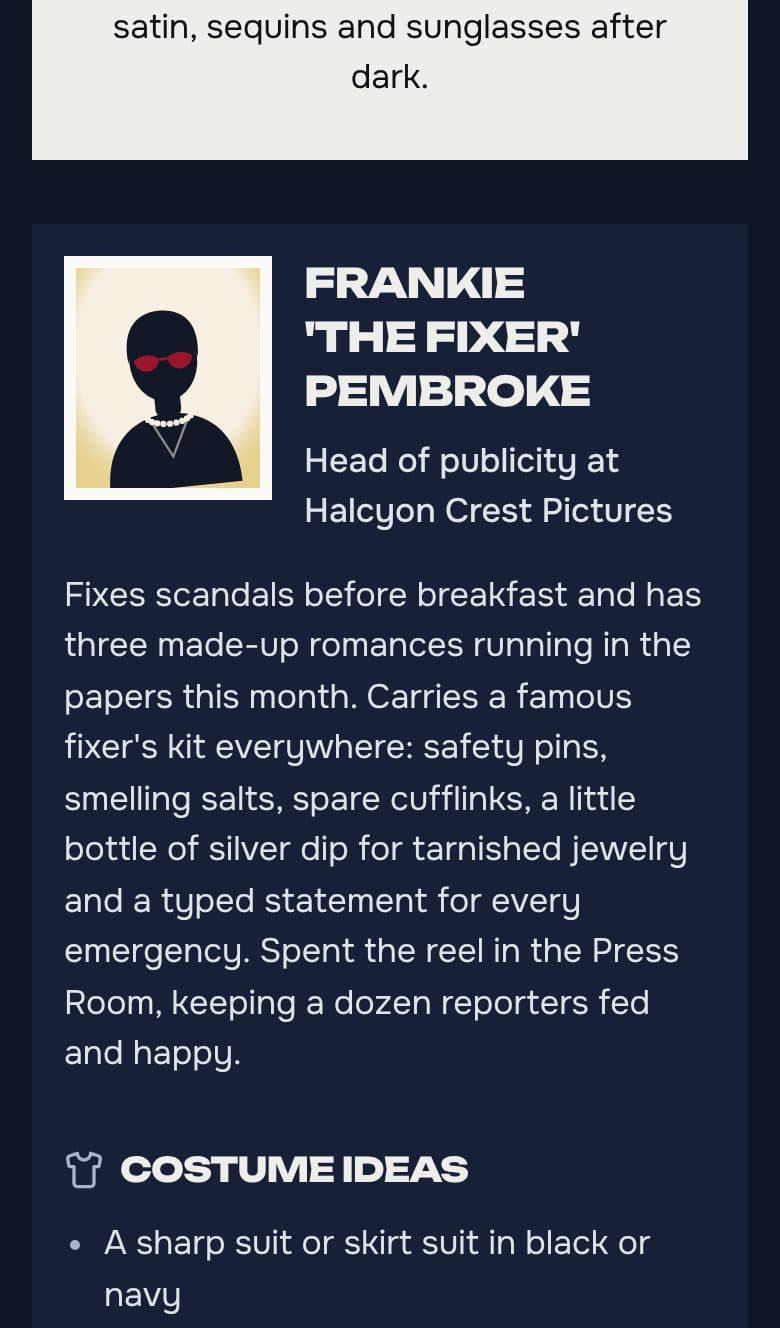
Their part 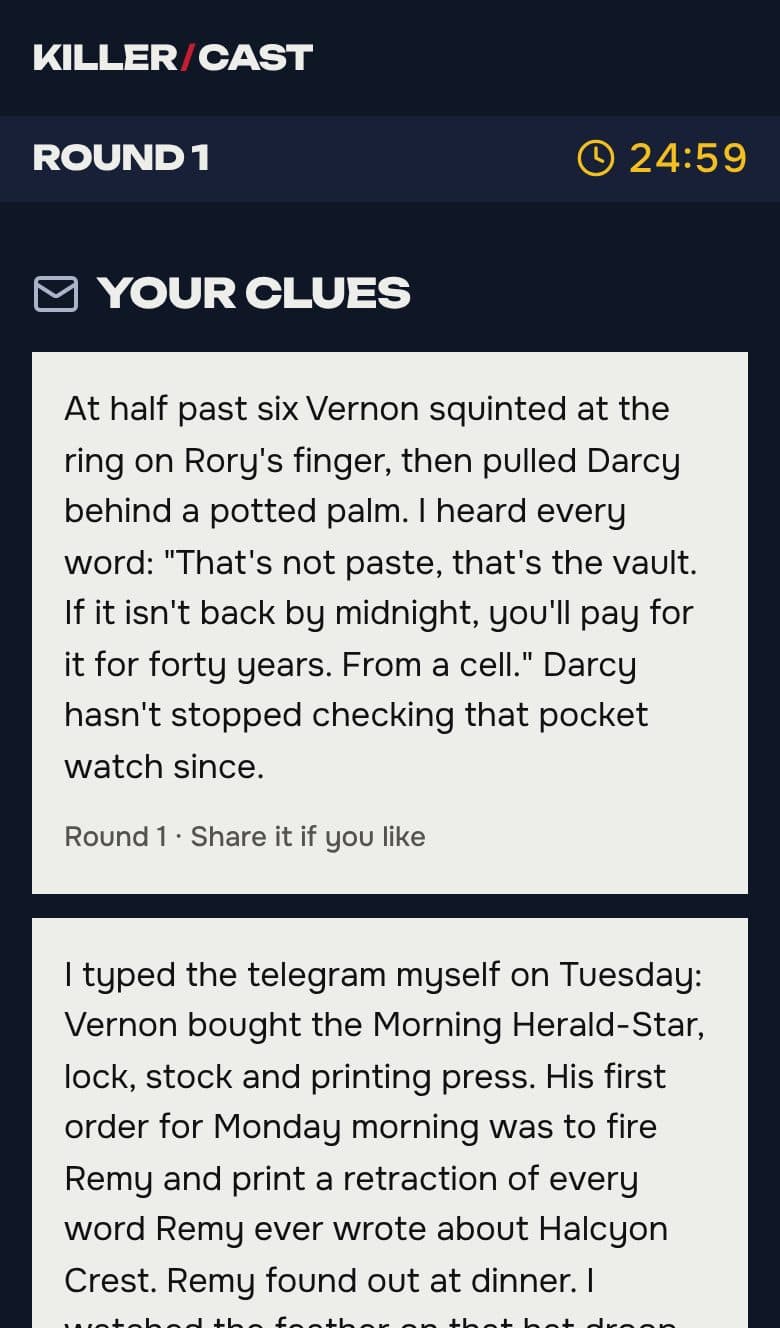
Clues each round 
The Evidence Locker
One of them did it
Pick a theme, add your guest list and see your cast in seconds. The preview is free.