How a murder mystery party works
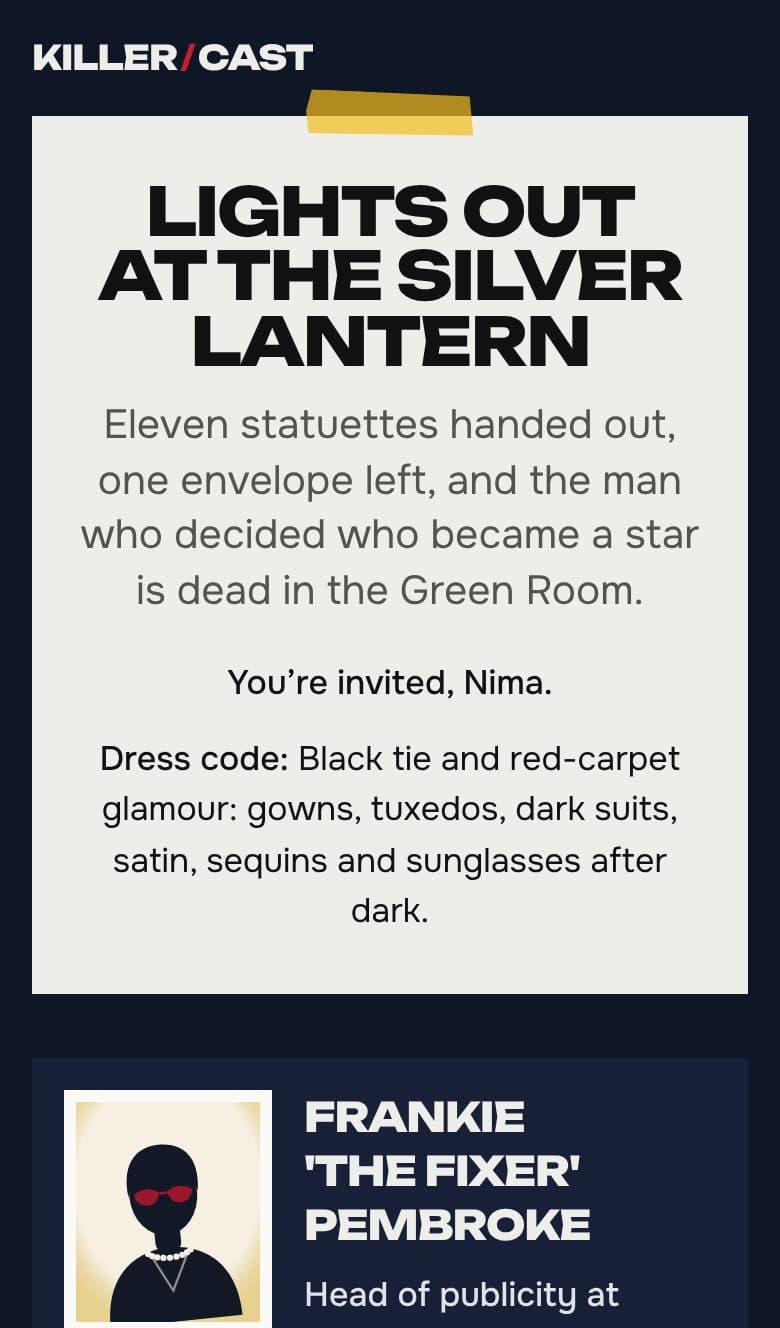
Before the party, every guest receives a character: a name, a role, a short public bio and costume ideas. On the night, a fictional victim is found (never one of the guests), and every character becomes a suspect. Each one has a secret, a reason to resent the victim and a few clues about everyone else.
One player is secretly the killer. Everyone else is innocent of the murder but probably guilty of something smaller, such as a forged letter, a hidden engagement or a missing bottle from the cellar. Over three rounds of conversation, clues and evidence, the group pieces together the truth. Then everyone makes an accusation and the solution is revealed.
A typical night runs 90, 120 or 150 minutes, plus time to arrive and eat. The host either plays a suspect or runs the game, depending on whether they know the answer.
What you do each round
Every round has a purpose. If you lose track, check your character details or ask the host what this round is about.
- Arrival: get a drink, introduce yourself in character and learn who everyone is playing.
- Opening scene: the victim is discovered and the host or narrator explains what happened. Listen for times and places; they matter later.
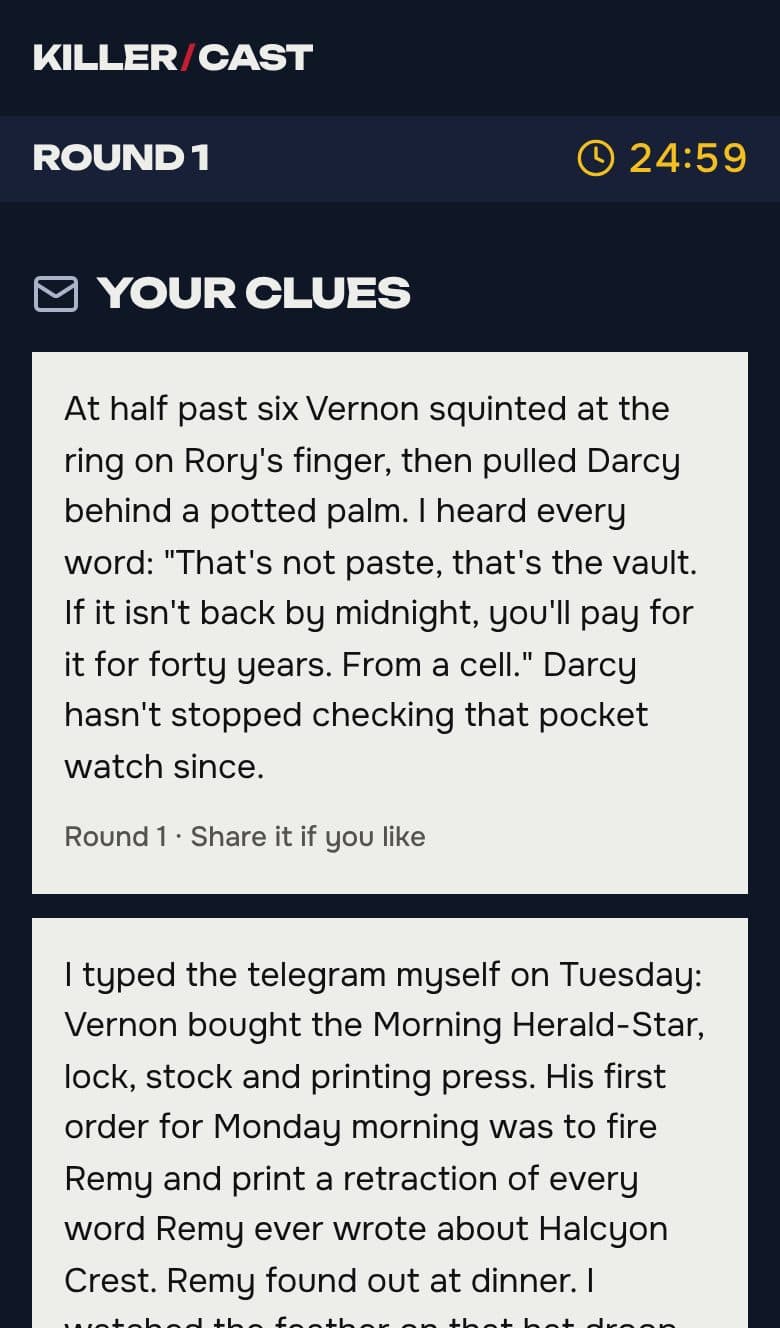
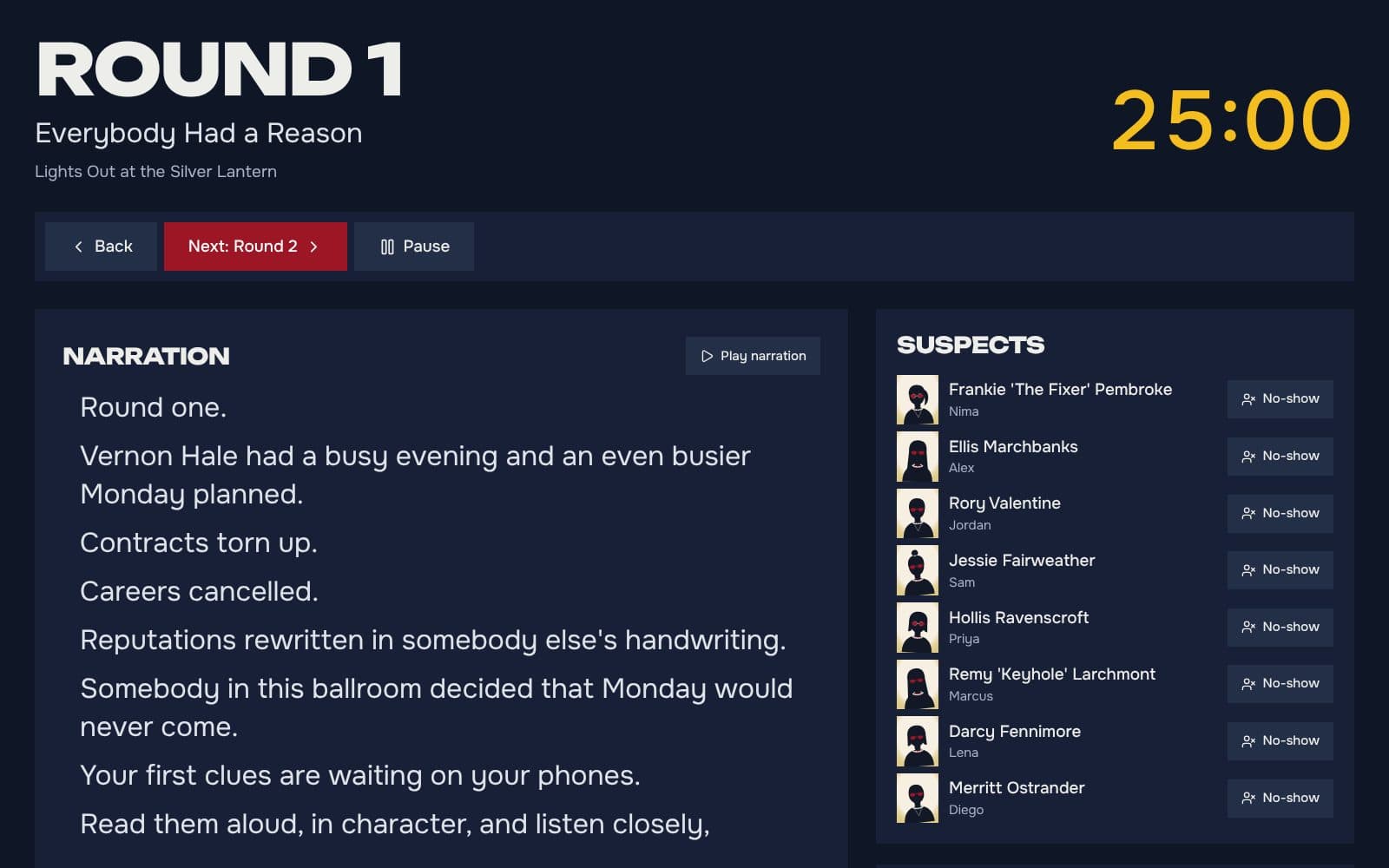
- Round one: read your objectives, share the clues marked for this round and ask people about their alibis.
- Round two: new clues and evidence unlock and motives start to surface. Compare notes with anyone you trust.
- Round three: the final clues arrive. Test your theory against the timeline and look for anyone whose story changed.
- Accusations: name the killer, the motive and the method, ideally in writing.
- Reveal: the solution and the trail of clues, followed by awards.
Sharing clues
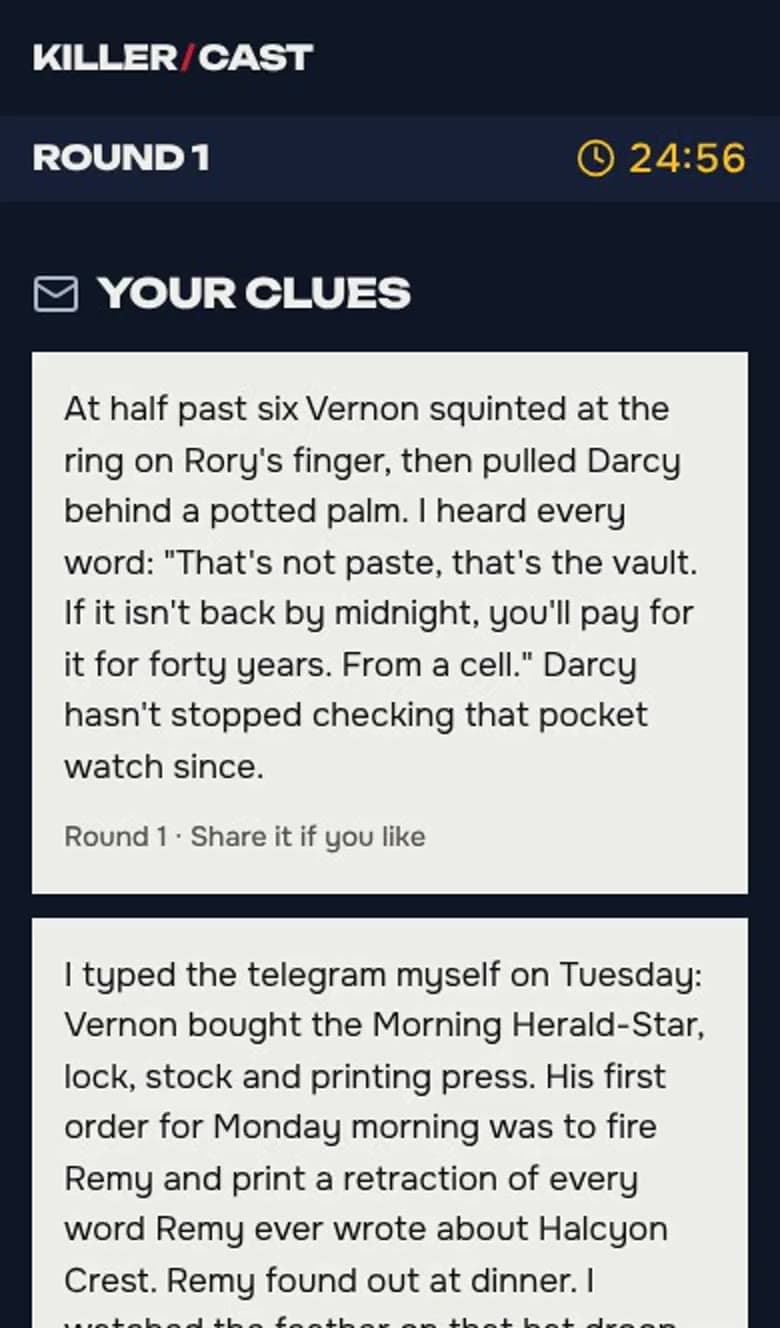
Clues come in two kinds. Must-share clues are the facts the case depends on, and you're expected to reveal them during the round they belong to, by reading them aloud, showing the card or bringing them up in conversation. Private information, like your character's secret, is yours to protect unless your objectives say otherwise.
Share generously. A mystery can be solved only when the must-share clues reach the group, so holding one back to look clever usually backfires. If you're unsure whether something should be shared, ask the host quietly.
Evidence works the same way. Letters, receipts, newspaper clippings and other documents are for everyone to examine. With Killer Cast, they live in an interactive Evidence Locker that unlocks round by round, with a red-string board and a timeline the group can build together.
The lying rules
This is where beginners get confused, so here are the rules in plain terms.
The result: any fact quoted from a clue card can be trusted unless it comes from the killer, and that kind of contradiction is exactly what good detectives notice.
- The killer may lie about anything, including where they were and what they saw.
- Everyone else must not lie about clues. If your card says you saw someone in the library at 9:40, you can't claim it was 10:15.
- Innocent players may keep their secrets. You can dodge, change the subject, answer a question with a question or say, “I'd rather not discuss that.”
- If someone asks you directly about a must-share clue, answer truthfully.
- Bluffing about feelings is fair game. “I adored the victim” is acting, not lying about evidence.
Accusations and scoring
When round three ends, every player makes an accusation. Writing it down or voting privately stops people from copying the loudest theory. A good accusation names three things: who did it, why and how. If you want points, this simple system works for any group.
Scoring is optional. Many groups skip points and hand out awards instead, such as Super Sleuth for the sharpest accusation and Best Performance for the most committed character.
- 1 point for naming the killer
- 1 point for the correct motive
- 1 point for the correct method
- 1 bonus point for citing the clue that cracked it
- 2 points for the killer if fewer than half the players name them
Etiquette for a great night
A murder mystery runs on goodwill. These habits keep it fun for everyone, including the host.
- Stay in character when you can, but step out to help anyone who looks lost.
- Don't read other players' cards or peek at the solution.
- Spread your conversations around: talk to at least three different people each round.
- Keep jokes about the characters, never about real guests' lives.
- Use your phone to check clues, not to scroll.
- Accept the reveal graciously, even if your theory was brilliant.
- Thank the host. Seriously.
Questions
Are you allowed to lie in a murder mystery party?
Only the killer may lie outright. Everyone else can keep secrets, dodge questions and bluff about feelings, but must not lie about what their clues say.
Does the killer know they're the killer?
Yes. The killer's character details say so privately, along with tips for staying calm under questioning. Nobody else knows until the reveal.
What if nobody guesses correctly?
That happens, and it's still fun. Walk through the clue chain at the reveal so everyone sees what they missed, and give the killer a well-earned award.
Do I need to study anything before the party?
Just read your character details once or twice. Learn your name, your role and your secret; everything else is on your card or your phone during the game.